Showing posts with label Falcon. Show all posts

Monday, August 29, 2016

SpaceX has a very busy launch schedule - 8 possible launches before year end

SpaceX appears fully recovered from it's single mission failure last year. They have managed several landings - first at it's new landing site at Cape Canaveral and then at sea - a much more difficult task, but an important one as not all missions are able to send the rocket all the way back to the cape. Landing the Falcon 9 rocket has always been a secondary mission objective - but a very important one in support of SpaceX's reusable rocket goal.

Rocket reusability is not only important for its cost savings, but also for the ability to shorting the time between launches. Even now the company is turning out missions faster than has ever been done before. And with the current schedule it will be launching multiple rockets in a single month. Here is the current launch schedule (with a lot of the exact launch dates still TBD):

Sept. 3Amos 6
Sept. 19Iridium Next 1-10
OctoberSES 10
OctoberEchoStar 23
OctoberFermosat 5 and Sherpa
NovemberSES 11 (EchoStar 105)
NovemberFalcon Heavy Demo Flight
Nov. 11CRS 10 (SPX 10)

Even with the their track record of quick turn arounds, this schedule would not be possible if all of the launches were from SLC-40 at Cape Canaveral. But with some flights out of Vandenberg AFB, and Falcon Heavy launching from the reconfigured SLC-39A at Kennedy Space Center, it could just happen.

Speaking of Falcon Heavy, with several rockets having been successfully landed now, it is what I'm looking forward to next (and I'm sure I'm not alone). Falcon Heavy has been anticipated for some time now. And had the big rocket just made a successful flight and ended up as the foundation of a new reef in the Atlantic, I would have been thrilled. But with the current landing success rate - and the presence of the landing complex - the possibility of the three Falcon 9 rockets separating and each landing itself autonomously is a real possibility. Would that be a sight to see!

Then what? We still have the manned Dragon 2 as well as the new Raptor engine (with greater power and re-useablity) to look forward to. And with these the company truly will be on course toward its big, red goal.


Falcon Heavy

Thursday, April 16, 2015

Video of SpaceX Falcon 1st stage landing attempt [Updated]

[Update] SpaceX engineers have examined the data and believe that sub-par performance of a throttle valve prevented a successful landing.  Per Elon Musk's tweet below, the next attempt will be in two months - which aligns with the CRS-7 mission (scheduled for June 19th).  This is consistent with previous announcements that the next landing attempts would be CRS-7 and CRS-8.
"Cause of hard rocket landing confirmed as due to slower than expected throttle valve response. Next attempt in 2 months." — Elon Musk (@elonmusk) April 18, 2015
SpaceX released this good quality video of the landing attempt to YouTube (watch on YouTube here). At first look I felt disappointment that it didn't stick the landing. That was replaced almost instantly by awe at that though that "this thing fell from the sky - not just the short distance on the video". Wow. As the rocket is just tipping over the "down hill" thruster (at the top of the stage) gives it's all to try to keep the the rocket vertical - but there's obviously too much inertia to overcome.


So, for an effort whose chances were estimated at 50/50, it was a brilliant achievement.

Tuesday, April 14, 2015

SpaceX "coming attractions" - what's next? [Updated]

The next mission kicks off in just 10 days, followed by a packed launch manifest for the remainder of the year and beyond.  Here is the schedule as it stands now.

April 27th [Updated]
TürkmenÄlem, the first telecommunications satellite for Turkmenistan
May TBD
Dragon V2 (manned spacecraft) pad abort test - while not actually a "flight" is worth noting (NASA)
June TBD
Second launch of Orbcomm satellites to complete the OG2 constellation
June 19
ISS resupply mission CRS-7 (NASA)
July TBD
SES-9 geo-transfer orbit (GTO) mission, with the SES-9 spacecraft joining the previously launched SES-8 in geosynchronous orbit
July 22
Jason 3 Earth observation satellite for monitoring and measuring the world’s oceans (NOAA)
Sept 2
ISS resupply mission CRS-8, Bigelow Aerospace's Bigelow Expandable Activity Module (BEAM) - an expandable (as in inflatable) compartment (NASA)
Sept TBD
The second dual-GTO mission for the Eutelsat 117W B and ABS-2A satellites
Dec 9
ISS resupply mission CRS-9 (NASA)
Mar TBD (2016)
Falcon Heavy Test Flight!
TBD
AMOS-6 satellite
JCSat 14 satellite
SAOCOM 1A and 1B Earth observation satellites (separate launches).

Monday, April 13, 2015

Launch postponed until tomorrow (4/14)

The launch of the SpaceX NASA CRS-6 mission has been delayed due to a potentially hazardous weather-related launch condition (the anvil cloud rule for thunderstorm clouds).  The next launch window is tomorrow at 4:10 PM (eastern).  Watch live on the SpaceX Lifestream channel.

This launch will include the latest attempt at landing the Falcon 9 rocket's first stage, hopefully advancing the goal of a reusable rocket,  This capability has been called a game changer by Elon Musk, shattering not only the launch price, but also the interval between launches.
 
So far 2015 has been very busy, with three flights in as many months.  With as many as 12 more flights slated for this year - including tomorrow's CRS-6 - this year should see more than twice the number of launches as 2014 (six missions) - and may include the first Falcon Heavy demo flight.

Exciting times for this visionary, but still quite young, company.

Monday, April 14, 2014

SpaceX still struggling to get CRS-3 launched

The latest resupply mission to the International Space Station (ISS) has been scrubbed again.  Scheduled to launch today, the SpaceX CRS-3 mission launch was scrubbed because of a  helium leak on the Falcon 9 rocket’s first stage.

The next opportunity will be Friday, April 18th at 3:25 pm EDT (although the weather is iffy).

The mission was originally slated for Q4 of 2013, with many dates slipping due to a packed launch schedule at the cape, coupled with a slip in the ISS berthing schedule due to multiple planned space walks to fix the December 2013 cooling issue on the station.  These not only impacted SpaceX's resupply mission, but Orbital's Cygnus resupply mission launch as well.  The schedule was then scheduled for no sooner than February 7, which was also pushed back to March 1 - and then March 16.  These schedule slips were followed by several unsuccessful attempts, including:

March 16th - launch was postponed after static firing of the engines due to “open items” that "require additional time to remedy".  Speculation included potential contamination in the cargo bay.

March 30 - launch was scrubbed when an Air Force tracking radar - part of a network that tracks launches - went off line impacting the public safety requirements for launching.

April 14 - launch as scrubbed due to a helium leak that is slated to be fixed in time for the April 18th launch window.

Look at this NASASpaceflight.com article for a really good write up of all of the events impacting the CRS-3 mission schedule.  Note that while these delays are bothersome, they are not unusual.

The mission itself is worth the wait and something I've been looking forward to for many months.

The main cargo resupply mission (CRS) mission objective continues to be the more routine job of getting cargo to and from the ISS - if anything as complex as a space mission can be called routine.  There will also be a secondary payload of five CubeSats under the ELaNa program.  ELaNa  is a NASA program to provide launch opportunities for educational CubeSat missions, and this will be the fifth launch under that program.

But what I'm really looking forward to is the second attempt at a soft splashdown to further SpaceX's long term goal of developing a reusable rocket.  A controlled descent of the Falcon 9 rocket was first tried on the maiden flight of the Falcon 9 version 1.1 from the Vandenberg Air Force Base.   The expectations for a successful controlled decent on that flight were very, very low.  And they are not very hight for CRS-3, but SpaceX will be taking every opportunity to test out their evolving capability, and the new Falcon 9 sports landing gear (as seen below) leading me to believe that every Falcon 9 flight going forward will include a controlled descent test.
CRS-3 Rocket with Landing Gear, source: Livestream


The same landing gear has been spotted on a new test vehicle being called Grasshopper 2 but the press.  If you've been following the Grasshopper project you will know that it is a test of controlled decent, performed on land in Texas.  If you re not familiar with Grasshopper you can read this to catchup (and see some great videos).  This new Grasshopper 2 test vehicle has landing gear that seems identical to the gear attached to the new Falcon 9 rocket.  This clearly indicates that SpaceX is going full speed ahead in developing it's reusable rocket capability - which could be a game changer in terms of launch costs.

Below is a picture of the new Grasshopper 2 test vehicle with the new landing gear.  The inset on the left shows the landing gear on the original Grasshopper.  Photo courtesy of this Redit post.

It is not clear if this gear is retractable like the gear on the Falcon 9.

Sunday, November 24, 2013

SpaceX SES-8 - First GEO Mission - Is about to launch

UPDATE - 11/26: After several holds on the countdown, the launch was scrubbed and is now rescheduled for an attempt on Thursday at 5:38 PM eastern time.

This mission will be the first to demonstrate the Falcon 9's ability to place cargo into geospatial orbit.  GEO (Geospatial Earth Orbit), is an orbit where the inertia of the spacecraft (typically a satellite) balances the pull of Earth's gravity allowing the spacecraft to maintain a fixed position above the Earth.  This allows ground stations on Earth to point antennas at a fixed position.   

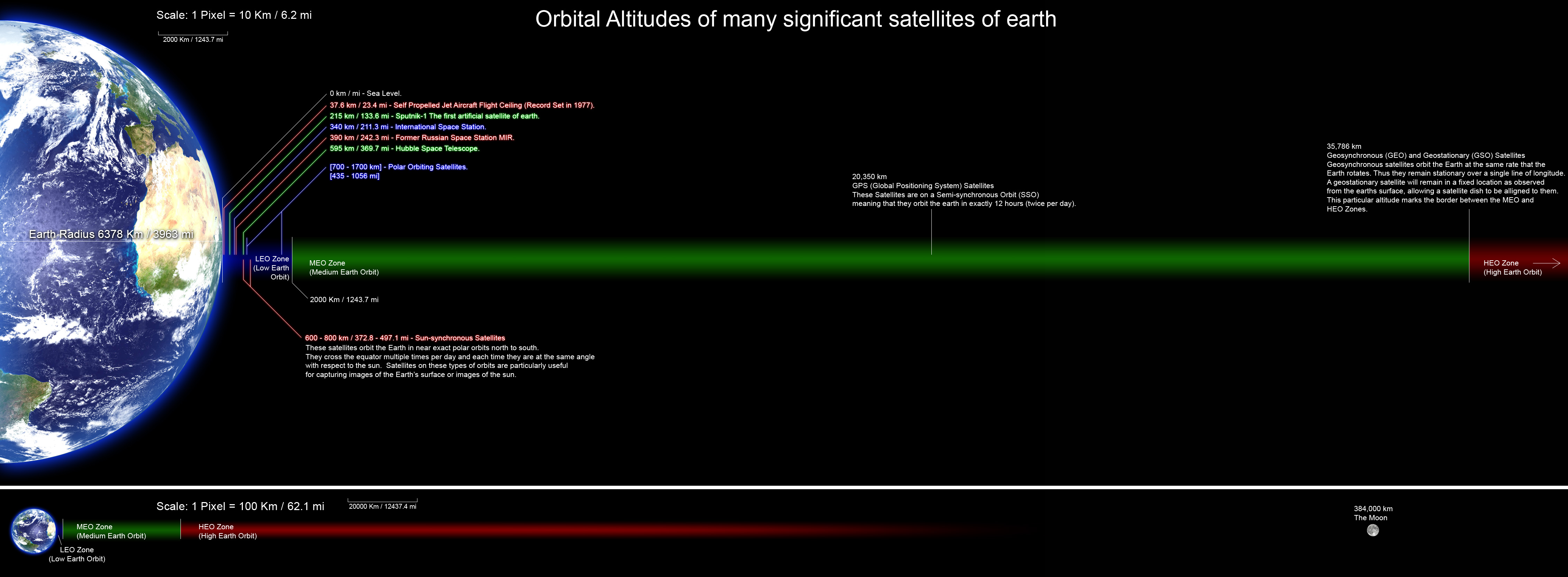
So, what's so special about a mission to place payload into GEO?  Primarily the distance of the this orbit.  Previous SpaceX missions (even the missions to the International Space Station) have been to an altitude in a range called Low Earth Orbit (LEO).  LEO is in the range of 160 kilometers (99 miles) to 2,000 kilometers (1,200 miles).  Which may seem pretty high, but GEO is more that ten times higher at an a;titude of 35,786 kilometres (22,236 mi).  The difference is illustrated in this image

It requires a more powerful rocket in order to get any significant amount of payload into GEO, and for SpaceX that means using the upgraded 1.1 version of the Falcon 9, with the more powerful Merlin 1D engines.  Because of such differences between LEO and GEO capabilities, rocket specifications list the payload capabilities for each.  For the Falcon 9 (v1.1) it is 4,850 kilograms (10,692 pounds) to GEO versus 13,150 kilograms 28,991 (pounds) to LEO.  Meaning a little over a third as much payload can be delivered to GEO as can be delivered to LEO.

So, this will be another important milestone for SpaceX.  It will demonstrate the ability to reach much farther into space, which not only opens up new markets but also forwards the goal of one day landing on Mars.

The launch can be view live at http://new.livestream.com/spacex/SES8.


Monday, September 30, 2013

SpaceX launches new rocket from a new launch facility

Photo of  of the launch of the SpaceX Falcon 9 version 1.1 rocket.
SpaceX successfully launched its new 1.1 version of the Falcon 9 rocket yesterday under a beautiful blue California sky.

The 1.1 version of the rocket is longer (for more fuel) and features the new, more powerful, Merlin 1D engines.  It also flew with a larger cargo faring that provides both more protection and more cargo volume.  There are other minor differences in the 1.1 version as well, such as updated flight avionics, and the rearrangement of the booster's engines in a circular arrangement as opposed to the 3x3 grid of the previous rocket.

This is also the first launch from the new Vandenberg Air Force Base launch site.  This is the site that should soon see the first test of the Falcon Heavy rocket.  While I haven't heard much about the Falcon Heavy lately - its still on the launch manifest for 2014.  Additionally, the Vandenberg site provided the chance to try a controlled decent of the booster - an important capability that the Grasshopper project is working towards.  The first part of the controlled decent went well, but the second burn put the booster into a spin, so controlled decent didn't happen - but it really wasn't expected to.  Since this launch provided an opportunity give it a try, an attempt couldn't be passed up, and I'm sure it yielded valuable data.  The next two launches will not afford another attempt as they will require all of the rocket's available fuel to get its payloads into geosynchronous orbit.  So, although SpaceX is still firmly committed to booster reusability, full flight testing will have to wait a while.

And those next launches will be another first for SpaceX, as all of its launches to date have been to LEO (low earth orbit).  In case you aren't intimately familiar with the different Earth orbits, Low Earth Orbit (LEO) is generally between 160 kilometers (99 mi) and 2,000 kilometers (1,200 miles).  Geosynchronous orbit however is approximately 35,786 km (22,236 mi) -  nearly 20 times higher!

Additionally, after deploying the payload, an attempt to reignite the second stage Merlin 1D in order to demonstrate its ability to restart in space, was unsuccessful.  During the restart the engine detected a problem and aborted the burn.

But the primary missions of demonstrating the Falcon 9 v1.1 rocket, and of placing its six payloads into stable orbit were complete successes.  The primary payload was the Cascade Smallsat and Ionospheric Polar Explorer (CASSIOPE) satellite.  The secondary payloads included the Polar Orbiting Passive Atmospheric Calibration Spheres (POPACS) CubeSat, the Drag & Atmospheric Neutral Density Explorer (DANDE) spherical spacecraft, and the CUSat technology demonstrator satellite.

Read more about these payloads, and all of the mission's details in the press kit, and be sure to check out these hi-res photos and videos.

Monday, March 18, 2013

Another first for SpaceX

As I wrote previously, SpaceX used the Dragon spacecraft's unpressurized "trunk" to carry additional large cargo pieces to the ISS this trip.  The unpressurized trunk section is separated from the main, pressurized, section and is not accessible via the docking hatch.  So the space station's robotic arm had to be used to unload the cargo from the "trunk".  This represents another SpaceX mission first, and clears the way for addition cargo in CRS-3 and CRS-4 later this year and early next year.  Both of these have cargo on the manifest that will fly in the unpressurized trunk.
A really good article about the robotic unloading (and the mission as a whole) is here on the nasaspaceflight.com site.

Monday, March 11, 2013

A big hop for SpaceX's Grasshopper

On March 7th, the SpaceX Grasshopper doubled its previous best height.  Reaching 262.8 feet (80.1m), hovering for several seconds, and descending gently to the ground - all with perfect looking control.  Starting from a mere 6ft hop, Grasshopper has been steadily increasing the size of its hops as shown here and here.  The goal of Grasshopper is to provide the research that will lead to a reusable launch platform.  Such a platform will be able to launch payloads into orbit, autonomously land, and then be refitted and relaunched.  This will significantly reduce cost and turn around time.

Check out the video.  Its a little hard to tell the scale of this rocket, but it's 10 stories tall and quite heavy - which makes this a pretty impressive feat.