Showing posts with label Cape Canaveral. Show all posts

Sunday, January 28, 2018

Falcon Heavy launch date set! Feb. 6th at 1:30 PM EST

Elon Musk announced yesterday that the Falcon Heavy could launch as soon as February 6th.  A tentative three hour launch window was set for 1:30 PM EST.

I've been waiting years for this - and I know I'm not alone!

Mark you calendars and tune in to the live launch at the SpaceX Webcast page.

Check out this this spaceflightnow.com post for more details.

Tuesday, December 19, 2017

Last SpaceX mission has some of the best video yet.

The broadcast of the recent CRS-13 mission provided some of the best mission video I've seen.  Clear, daytime launch yielded some spectacular video of the launch and landing of the Falcon 9 first stage.
You can watch the replay here:
https://www.youtube.com/watch?v=OPHbqY9LHCs

Here is a quick reference of where some of the highlights occur, for those of you in a hurry.

16:50 - Close shot of the Falcon 9 rocket
18:30 - Stage separation - An external shot, not the typical shot from inside the second stage
Followed by the boost back burn (the camera following the first stage).
19:10 - The protective nose cover jettisoned from Dragon shoots past
21:10 - Cape Canaveral comes into view from the first stage camera
The next 30 seconds show the reentry with one very short video drop
23:15 - First stage landing burn starts, detail of the landing zone becomes clear
26:00 - Dragon separates.  Great video of Dragon heading away from the second stage, detail of dragon’s trunk with the earth filling the upper portion of the frame
26:40 - Dragon still visible with good detail


Additionally a great, almost continuous, external landing video was produced.  It can be seen here:
https://www.youtube.com/watch?v=Z6RPfXSRww4

Monday, December 11, 2017

SpaceX to cap busiest year with CRS-13 launch tomorrow [UPDATE: Launch delayed until 12/13]

Update: Today's scheduled launch has been delayed until tomorrow, December 13th, in order to perform additional ground system checks.

SpaceX is scheduled to launch the latest International Space Station (ISS) resupply mission tomorrow, carrying nearly two and a half tons of cargo the ISS.  This launch will be the 17th this year (if I haven't lost track), and is remarkable in that it will be reusing both the Dragon capsule and the Falcon 9 rocket.  The capsule previously visited the ISS in April 2015, while the Falcon 9 is a newer model launched in June of this year.

The launch also marks the return of operations to SLC-40, which has been out of commission since September 2015, when an accident during a static fire test knocked it out of commission.  This will in turn free up LC-39A allowing preparations to continue for the first Falcon Heavy launch, which the company hopes to launch next month.

The launch is schedule for December 12th at 11:46 EST, with a backup window on December 13th at the same time.

Monday, October 2, 2017

Fall 2017 - a busy and exciting time for SpaceX


Sprinkled into the SpaceX launch manifest for this fall, and the first quarter of 2018, are two big milestones: the Falcon Heavy and Crew Dragon demos.

Also this month, SpaceX will once again have two back to back missing with the
SES 11/EchoStar 105 mission launching from Kennedy Space Center on the 7th, and the Iridium Next 21-30 mission launching from Vandenberg Air Force Base on the 9th.

Falcon 9 -SES 11/EchoStar 105
October 7, 2017 at 6:53 PM. EDT (2 hour window)
LC-39A, Kennedy Space Center, Florida

Falcon 9 - Iridium Next 21-30
October 9th, 2017 at 8:37 AM EDT (5:37 AM PDT)
SLC-4E, Vandenberg Air Force Base, California

SpaceX has 58 missions listed on its launch manifest. Of these 58, the following - which include 3 Falcon Heavy flights and the Crew Dragon Demo - have been announced:
Falcon 9 - Koreasat 5A
October 30, 2017 at 3:34 PM. EDT (window extends to 5:58 PM)
Cape Canaveral, Florida

Falcon 9 - Hispasat 30W-6
4th Quarter 2017
Cape Canaveral, Florida

Falcon Heavy Demo Flight
November 2017
LC-39A, Kennedy Space Center, Florida

Falcon 9 - Iridium Next 31-40
Late November 2017
SLC-4E, Vandenberg Air Force Base, California

Falcon 9 - SpaceX CRS 13
November 28 (launch time TBD)
Cape Canaveral, Florida

Falcon 9 - Bangabandhu 1
December 2017
Cape Canaveral, Florida

Falcon 9 - SES 16/GovSat 1
Late December 2017
Cape Canaveral, Florida

Falcon 9 - Iridium Next 41-50
January 2018
SLC-4E, Vandenberg Air Force Base, California

Falcon 9 - SpaceX CRS 14
February 9 (launch time TBD)
Cape Canaveral, Florida

Falcon Heavy - Arabsat 6A
Early 2018
LC-39A, Kennedy Space Center, Florida

Falcon 9 - TESS
Sometime after March 20, 2018
Launch site: SLC-40, Cape Canaveral Air Force Station, Florida

Falcon 9 - Crew Dragon Demo 1
April, 2018
LC-39A, Kennedy Space Center, Florida

Falcon Heavy - STP-2
Sometime after April 30, 2018
LC-39A, Kennedy Space Center, Florida


Thursday, February 16, 2017

SpaceX to launch from the historic Kennedy Space Center site LC-39A [Update 2/18]

[Update 2/18] The launch was scrubbed at T-0:13 "out of an abundance of caution"  because of an upper stage thrust vector control issue.  Per Elon Musk on Twitter "the movement trace of an upper stage engine steering hydraulic piston was slightly odd" according to Elon Musk.  He added "If this is the only issue, flight would be fine, but need to make sure that it isn't symptomatic of a more significant upstream root cause".  Better to error on the side of caution.  The next window is tomorrow, Sunday the 19th, at 9:38 AM EST.

[Update] Elon Musk said on Twitter that there is a (very small) leak in the upper stage.  They are investigating and if it checks out they will attempt to launch tomorrow.  The rocket is on the pad and ready to go otherwise.


Launch Complex 39 at the Kennedy Space Center (KSC) is steeped in history.  It is comprised of two launch complexes: LC-39A and LC-39B.  These sites, built to support the Apollo program, launched the most powerful rockets built - the Saturn V.  They were later adapted for the Space Shuttle program.  So they've witnessed many historic launches (with some really big rockets).  LC-39A was used for most of the manned Apollo launches, including the Apollo 11 mission that landed the first men on the moon, and was watched by millions on TV.

SpaceX secured a lease for LC-39A and has been adapting it for it's Falcon 9 and Falcon Heavy rockets. This site will be used by SpaceX for the first time this Saturday with the launch the CRX-10 mission to resupply the ISS.  With this mission being a LEO mission, there will be ample fuel to make a landing at the SpaceX Landing Complex 1 at Cape Canaveral .  Coming off of a string of successful landings at sea, this will attempt to be the third landing at Landing Complex 1 (with the first being the second OG2 mission landing, which was the first successful landing for SpaceX anywhere).

This will be the first launch from LC-39A since the Space Shuttle program ended.  The launch is scheduled for 10:01 AM EST (15:01 GMT) tomorrow (Saturday February 18th) - weather permitting of course, which is questionable at this time.

The Falcon 9 has been lifted onto the pad (watch this nice time-lapse video of the process) in preparation for launch.  Unlike the Saturn V that was assembled vertically in the vertical assembly facility and wheeled to the pad standing up, the Falcon 9 rocket is prepared while laying horizontally, and is then stood up at the launch pad.

The NASA page for the mission is here, and the live webcast of the launch can be found on the SpaceX Webcast page or at the SpaceX YouTube site (choose the hosted version unless you're a seasoned launch watcher).

Monday, August 29, 2016

SpaceX has a very busy launch schedule - 8 possible launches before year end

SpaceX appears fully recovered from it's single mission failure last year. They have managed several landings - first at it's new landing site at Cape Canaveral and then at sea - a much more difficult task, but an important one as not all missions are able to send the rocket all the way back to the cape. Landing the Falcon 9 rocket has always been a secondary mission objective - but a very important one in support of SpaceX's reusable rocket goal.

Rocket reusability is not only important for its cost savings, but also for the ability to shorting the time between launches. Even now the company is turning out missions faster than has ever been done before. And with the current schedule it will be launching multiple rockets in a single month. Here is the current launch schedule (with a lot of the exact launch dates still TBD):

Sept. 3Amos 6
Sept. 19Iridium Next 1-10
OctoberSES 10
OctoberEchoStar 23
OctoberFermosat 5 and Sherpa
NovemberSES 11 (EchoStar 105)
NovemberFalcon Heavy Demo Flight
Nov. 11CRS 10 (SPX 10)

Even with the their track record of quick turn arounds, this schedule would not be possible if all of the launches were from SLC-40 at Cape Canaveral. But with some flights out of Vandenberg AFB, and Falcon Heavy launching from the reconfigured SLC-39A at Kennedy Space Center, it could just happen.

Speaking of Falcon Heavy, with several rockets having been successfully landed now, it is what I'm looking forward to next (and I'm sure I'm not alone). Falcon Heavy has been anticipated for some time now. And had the big rocket just made a successful flight and ended up as the foundation of a new reef in the Atlantic, I would have been thrilled. But with the current landing success rate - and the presence of the landing complex - the possibility of the three Falcon 9 rockets separating and each landing itself autonomously is a real possibility. Would that be a sight to see!

Then what? We still have the manned Dragon 2 as well as the new Raptor engine (with greater power and re-useablity) to look forward to. And with these the company truly will be on course toward its big, red goal.


Falcon Heavy

Thursday, May 26, 2016

[Update: postponed, will try again tomorrow. SpaceX Thaicom launch scheduled to today

SpaceX is scheduled to launch  a Thaicom communications satellite shortly.  Window opens at 5:40 PM ET, (9:40 PM UTC).  

Due to the nature of this launch another attempt at a landing at sea will be attempted. As always, these attempts are secondary to the main mission.  The landings at sea are much more challenging, but the company has completed two in a row now.   Despite this success the company is trying to keep expectations low. 

Speaking of these landings, I didn't manage to post about the last mission. That mission provided SpaceX its second sea landing in a row. And it was a spectacular one. The live feed started with a pitch black view from the deck, followed by a blaze of light so bright in contrast that my first thought was that it ended in a fire ball. But the engines cut off and the smoke cleared and there was the Falcon standing perfectly.  It was quite a thrill, and as you can imagine the SpaceX facility erupted in cheers. 

SpaceX is back to turning around launches at a rapid pace - catching up on their backlog - and showing that they are "back in the game". 

Friday, April 8, 2016

UPDATED: Space Station supply mission today as SpaceX resumes its CRS schedule.

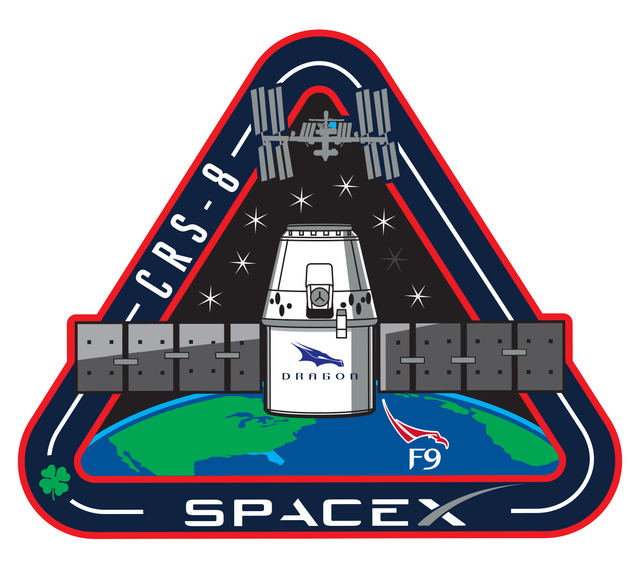
SpaceX CRS-8 mission patch
UPDATE: SpaceX has stuck the landing!  This is first successful Falcon 9 landing at sea, and was shown in real time on the live broadcast.  Congratulations!

SpaceX is sending Dragon to the ISS as it resumes its schedule of resupply missions.  The CRS-8 mission will launch shortly - 4:43 PM EDT (Apr 8, 2016).  As usual for CRS missions, the launch will be from Space Launch Complex 40 at Cape Canaveral Air Force Station.

Once again, the Falcon 9 will attempt to land on the droneship “Of Course I Still Love You” (in the Atlantic Ocean).  These landings are always experimental and secondary to the main mission, but still highly anticipated.  A landing has yet to be made to a droneship, but a successful landing to the Cape Canaveral landing site was accomplished (and was fantastic to watch!), so a success at sea is not at all out of the realm of possibility.  SpaceX has been getting closer and closer.

As a reminder to those familiar with the Dragon resupply missions (or for those of you that haven't previously followed these missions), SpaceX is the only space station resupply vendor that is able to return relatively large amounts of cargo back from the ISS.  Other CRS missions send cargo to the ISS, but since the retirement of the space shuttle there has been a void in the capability to return significant amounts of cargo.

Live feed (and replay) at http://www.spacex.com/webcast
Press kit is at http://www.spacex.com/press/2016/04/07/press-kit-crs-8-dragon-mission

Wednesday, February 24, 2016

UPDATE: SpaceX SES-9 mission scheduled now set for Friday March 4th at 6:35 PM EST

UPDATE: The SES-9 launch has been scrubbed several times due to a variety of different issues - ranging from a fuel loading issue, to weather conditions, to marine traffic in the 1st stage landing zone.   The launch is currently scheduled for the same launch window (starting at 6:35 PM EST) on Friday, March 4th.

SpaceX is taking another step towards returning to a normal launch schedule with the launch today of the SES-9 mission. The mission goal is to deploy an SES communications satellite into GTO (Geostationary Transfer Orbit).

There is a generous 90 minute launch window, with a backup window starting at 6:46 pm EST tomorrow (February 25).

Mission details are available in the SpaceX Press Kit, and will be webcast as usual here.

As this is a GTO mission, the first stage recovery attempt be to the “Of Course I Still Love You” droneship. The nature of the mission does not allow for a return to the Cape Canaveral landing site, and a successful landing at sea has not yet been achieved, and is also not expected to succeed with this mission profile. However, every attempt provides more experience and data to allow SpaceX to eventually make drone ship landings a possibility for those missions where it is required.

Monday, December 21, 2015

SpaceX Falcon 9 sticks the landing!

SpaceX just accomplished what they have been building up to for years.  They have successfully brought the Falcon 9 booster back to earth and landed it on their new landing site.

The is truly an exceptional feat, and ushers in the beginning of a new era in space flight.  An era where valuable time and resources are recovered and put back into service instead of being dumped into the ocean.

Congratulations!!

[Update - Video of the landing from the landing pad (from the webcast) and a short aerial view taken from a helicopter]


Saturday, December 19, 2015

SpaceX ORBCOMM OG2 Mission 2 is on for tomorrow


[Dec. 20 update] In a tweet, Elon Musk said that the flight simulations showed a 10% better chance of a successful landing tomorrow (Dec. 21st), and therefore the launch will be rescheduled for the 5 minute launch window that opens at 8:29pm ET, Monday Dec. 21st.  The SpaceX site has also confirmed that they will attempt to land the Falcon 9 on land (instead of the previous attempts at sea).  And they stated that both the launch and the landing attempt will be webcast live.  The webcast is already up and is showing photos of the rocket on the pad and looking ready to go.  The SpaceX site also reminds everyone that the landing is a secondary test objective - in other words, mission success is not dependent on a successful landing.

It looks like it's a "go" for tomorrow nights launch of the second ORBCOMM OG2 mission, marking SpaceX's return to normal flight operations following the failure of the CRS-7 mission in late June.

The ORBCOMM web site now has a live countdown on it, and the mission page had been update with this announcement:
We are excited to report SpaceX completed their static fire test of Falcon 9 this evening. We are now targeting ORBCOMM’s OG2 Mission 2 launch for no earlier than Sunday, December 20 at 8:29 PM ET from launch pad SLC-40 at Cape Canaveral Air Force Station in Florida.
Also, the Livestream event for the launch has just been created.  So, as with all of the recent SpaceX launches, there will be live coverage via Lifestream.

Thursday, December 10, 2015

SpaceX to test fire the upgraded Falcon 9 in preparation for a possible December 19th launch

SpaceX Logo
[Update] Current schedule is looking at a two hour launch window from 8:25 p.m. to 11:26 p.m. EST this Sunday, December 19th.  Launch site is SLC-40, Cape Canaveral Air Force Station, Florida.

According to the recent tweet from Elon Musk, "Aiming for Falcon rocket static fire at Cape Canaveral on the 16th and launch about three days later", it would appear that SpaceX and all the other involved parties are satisfied with the investigation of the CRS-7 mission failure in June.

The Falcon 9 static test fire will be conducted on the pad and is a prelude to a possible launch on December 19th. Following the test fire, engineers will review the all of the data, and if everything checks out an attempt can be made during the three hour launch window that opens at 8:25 p.m. EST (0125 GMT on Dec. 20). The launch will attempt to deploy 11 second-generation Orbcomm (OG2) communications satellites, delayed several times from its initial December 2014 schedule.

The SpaceX team has been making steady progress in preparing Falcon for it's return to duty. The struts that hold the pressurized tanks in place have been scrutinized and no doubt upgraded, being that they were implicated as the apparent cause of the launches failure. According to Elon Musk, "the likely cause was a broken bracket holding a high-pressure helium reservoir inside the Falcon 9’s second stage liquid oxygen tank. The strut apparently fractured under the stresses of launch, causing the helium tank to break free and rupture the upper stage while the first stage was still firing about two minutes after liftoff".

But, as always, the company is not standing still, and has changed the booster to provide a 33-percent increase in performance according to SpaceX's Lee Rosen (Vice President of Mission and Launch Operations). The slightly taller Falcon 9 "has the same engines that we’ve flown before, but with some upgrades and things like that to increase reliability and performance" according to Mr. Rosen. The upgraded Falcon 9 was test fired on Sept. 21st as can be seen in this video. Sited among the changes are increases in the thrust of both the first and second stages, modifications to the landing legs and grid fins (most likely to increase the chances for a successful landing), and many more tweaks. Contributing to the increased thrust is "densified propellant" - chilling the RP-1 fuel more in order to pack more fuel into the same space.

A return to operations will mean that SpaceeX will be able to chip away at it's mounting launch manifest (which was heavily loaded even before the almost half a year hiatus), with several space station resupply missions to make up in addition to the backlog of commercial launches. However, prior to the failed June mission, the company was demonstrating record turn around times, and so if all goes well it has the ability to get a lot of cargo into space in a relative short amount of time. And, with the successful November 23rd flight of the Blue Origin suborbital rocket - which landed safely after reaching the 100-kilometer (62-mile) boundary with space, the desire to stick the landing with the Falcon 9 rocket has to be an increasing important goal. One that the has been getting closer and closer each flight.

Friday, June 26, 2015

SpaceX CRS-7 launch scheduled for Sunday, June 28th

SpaceX logoSpaceX's seventh International Space Station (ISS) cargo resupply mission is scheduled for launch on Sunday, June 28th at 10:21 AM Eastern Time.

Live coverage of the event starts at 10:00 AM (Eastern Time) on the SpaceX Lifestream channel.
While the primary mission of all cargo resupply missions is to get cargo safely to and from the ISS, which is the only true measure of success, most people following SpaceX's reusable rocket goal will be even more interested in the secondary mission goal of attempting to land the Falcon 9 rocket.  This will be the latest in a series of attempts - with each attempt providing data for the next, and getting closer and closer to the goal.  This "must read" article on the SpaceX side provides the details along with some great images and video.

Tuesday, April 14, 2015

SpaceX "coming attractions" - what's next? [Updated]

The next mission kicks off in just 10 days, followed by a packed launch manifest for the remainder of the year and beyond.  Here is the schedule as it stands now.

April 27th [Updated]
TürkmenÄlem, the first telecommunications satellite for Turkmenistan
May TBD
Dragon V2 (manned spacecraft) pad abort test - while not actually a "flight" is worth noting (NASA)
June TBD
Second launch of Orbcomm satellites to complete the OG2 constellation
June 19
ISS resupply mission CRS-7 (NASA)
July TBD
SES-9 geo-transfer orbit (GTO) mission, with the SES-9 spacecraft joining the previously launched SES-8 in geosynchronous orbit
July 22
Jason 3 Earth observation satellite for monitoring and measuring the world’s oceans (NOAA)
Sept 2
ISS resupply mission CRS-8, Bigelow Aerospace's Bigelow Expandable Activity Module (BEAM) - an expandable (as in inflatable) compartment (NASA)
Sept TBD
The second dual-GTO mission for the Eutelsat 117W B and ABS-2A satellites
Dec 9
ISS resupply mission CRS-9 (NASA)
Mar TBD (2016)
Falcon Heavy Test Flight!
TBD
AMOS-6 satellite
JCSat 14 satellite
SAOCOM 1A and 1B Earth observation satellites (separate launches).

Monday, April 13, 2015

Launch postponed until tomorrow (4/14)

The launch of the SpaceX NASA CRS-6 mission has been delayed due to a potentially hazardous weather-related launch condition (the anvil cloud rule for thunderstorm clouds).  The next launch window is tomorrow at 4:10 PM (eastern).  Watch live on the SpaceX Lifestream channel.

This launch will include the latest attempt at landing the Falcon 9 rocket's first stage, hopefully advancing the goal of a reusable rocket,  This capability has been called a game changer by Elon Musk, shattering not only the launch price, but also the interval between launches.
 
So far 2015 has been very busy, with three flights in as many months.  With as many as 12 more flights slated for this year - including tomorrow's CRS-6 - this year should see more than twice the number of launches as 2014 (six missions) - and may include the first Falcon Heavy demo flight.

Exciting times for this visionary, but still quite young, company.

Wednesday, February 11, 2015

SpaceX Launch Tonight - DSCOVER Mission

First, my apologies for not having any posts in a while.  Hopefully I'll be back to a regular posting schedule going forward.

SpaceX DSCOVR mission patchSpaceX will (hopefully) launch the DSCOVR mission this evening at 6:03 PM EST.  This will be the third launch window, the first two attempts being scrubbed for technical and then weather reasons.

This mission represents another milestone for SpaceX: it's first deep space mission.  The mission will attempt to place the DSCOVR satellite into the Sun-Earth L1 Lagrangian point - a point where the gravitational forces of the Sun and Earth are equalized, allowing a satellite to maintain its position with minimal effort.  Why this is a big deal for SpaceX is that the Sun-Earth L1 is 1.5 million kilometers (930,000 miles) from Earth.  That's four times farther than the Moon, and over 40 times farther than any previous SpaceX mission.  While the satellite will be deployed 35 minutes after launch, it will take 110 days for it to arrive at its destination.

I haven't found any information about  plans to recover the Falcon 9 rocket.  SpaceX stated that they would be working towards a soft landing of the first stage on each mission, but the past SpaceX mission to geostationary orbit required so much fuel that an attempt wasn'
t possible, and it seems that would also be the situation with this launch.

Links:
The official SpaceX press kit
Watch live on Livestream starting at 5:45 PM EST.

Monday, April 14, 2014

SpaceX still struggling to get CRS-3 launched

The latest resupply mission to the International Space Station (ISS) has been scrubbed again.  Scheduled to launch today, the SpaceX CRS-3 mission launch was scrubbed because of a  helium leak on the Falcon 9 rocket’s first stage.

The next opportunity will be Friday, April 18th at 3:25 pm EDT (although the weather is iffy).

The mission was originally slated for Q4 of 2013, with many dates slipping due to a packed launch schedule at the cape, coupled with a slip in the ISS berthing schedule due to multiple planned space walks to fix the December 2013 cooling issue on the station.  These not only impacted SpaceX's resupply mission, but Orbital's Cygnus resupply mission launch as well.  The schedule was then scheduled for no sooner than February 7, which was also pushed back to March 1 - and then March 16.  These schedule slips were followed by several unsuccessful attempts, including:

March 16th - launch was postponed after static firing of the engines due to “open items” that "require additional time to remedy".  Speculation included potential contamination in the cargo bay.

March 30 - launch was scrubbed when an Air Force tracking radar - part of a network that tracks launches - went off line impacting the public safety requirements for launching.

April 14 - launch as scrubbed due to a helium leak that is slated to be fixed in time for the April 18th launch window.

Look at this NASASpaceflight.com article for a really good write up of all of the events impacting the CRS-3 mission schedule.  Note that while these delays are bothersome, they are not unusual.

The mission itself is worth the wait and something I've been looking forward to for many months.

The main cargo resupply mission (CRS) mission objective continues to be the more routine job of getting cargo to and from the ISS - if anything as complex as a space mission can be called routine.  There will also be a secondary payload of five CubeSats under the ELaNa program.  ELaNa  is a NASA program to provide launch opportunities for educational CubeSat missions, and this will be the fifth launch under that program.

But what I'm really looking forward to is the second attempt at a soft splashdown to further SpaceX's long term goal of developing a reusable rocket.  A controlled descent of the Falcon 9 rocket was first tried on the maiden flight of the Falcon 9 version 1.1 from the Vandenberg Air Force Base.   The expectations for a successful controlled decent on that flight were very, very low.  And they are not very hight for CRS-3, but SpaceX will be taking every opportunity to test out their evolving capability, and the new Falcon 9 sports landing gear (as seen below) leading me to believe that every Falcon 9 flight going forward will include a controlled descent test.
CRS-3 Rocket with Landing Gear, source: Livestream


The same landing gear has been spotted on a new test vehicle being called Grasshopper 2 but the press.  If you've been following the Grasshopper project you will know that it is a test of controlled decent, performed on land in Texas.  If you re not familiar with Grasshopper you can read this to catchup (and see some great videos).  This new Grasshopper 2 test vehicle has landing gear that seems identical to the gear attached to the new Falcon 9 rocket.  This clearly indicates that SpaceX is going full speed ahead in developing it's reusable rocket capability - which could be a game changer in terms of launch costs.

Below is a picture of the new Grasshopper 2 test vehicle with the new landing gear.  The inset on the left shows the landing gear on the original Grasshopper.  Photo courtesy of this Redit post.

It is not clear if this gear is retractable like the gear on the Falcon 9.

Tuesday, December 3, 2013

SpaceX SES-8 Mission Launch Successful

After a couple of delays, the launch of the SpaceX SES-8 mission has occurred.
The spacecraft has obtained the transfer orbit (GTO) needed to place the payload into GEO (Geostationary Earth Orbit).
As stated in my previous post, this is a first for the SpaceX Falcon 9 rocket (as for SpaceX as a whole).  Completion of this mission (and there is still a lot of mission left) will demonstrate SpaceX's ability to deliver payload to this much higher orbit.