Showing posts with label Rocket Reuseability. Show all posts

Sunday, January 28, 2018

Falcon Heavy launch date set! Feb. 6th at 1:30 PM EST

Elon Musk announced yesterday that the Falcon Heavy could launch as soon as February 6th.  A tentative three hour launch window was set for 1:30 PM EST.

I've been waiting years for this - and I know I'm not alone!

Mark you calendars and tune in to the live launch at the SpaceX Webcast page.

Check out this this spaceflightnow.com post for more details.

Tuesday, January 23, 2018

Falcon Heavy is launching soon. Here's some info about this historic launch.


There is plenty of information available about the Falcon Heavy.  But here are a few for my friends that get their SpaceX news from me instead of the dozens of space related sites (as well as the SpaceX Falcon Heavy page).
  • Falcon Heavy is comprised of 3 Falcon 9 rockets.  
  • It will be the most powerful rocket ever launched.  
  • The most powerful rocket since the Saturn V, which took us to the Moon.  
  • It will be over twice as powerful as any rocket currently flying (the Saturn V was retired in the early 70's).

The first "demo" launch will also be historic.
  • SpaceX will attempt to recover all three boosters: two will return to the SpaceX landing site near the lauch pad, and the center booster will attempt to land on the autonomous "drone" ship "Of course I still Love you".
  • It will be the first time a private company has launched a spacecraft beyond Earth's orbit.
  • It will be launching from the same historic launch pad that the Saturn V Apollo missions launched from.
  • The payload will be Elon Musk's personal Tesla roadster. 
And why launch a car into orbit around the Sun?
First, because something had to simulate a payload (dummy weight is usually used).

But mostly it seems it's because Elon Musk thinks it would be cool -- and it's his rocket, and his car, so...

But Tesla or not, a successful mission would provide valuable data for future Mars missions.

So, in addition to flight testing a new rocket configuration, the mission - if successful - will also be a tangible step towards landing on Mars, which has been the company's stated mission from the beginning.

But as Elon Musk said himself, is may also end in a big fireball.  "Some things can't be tested" without launching them.  There is a lot that could go wrong in something this complex.

But when?
Who knows.  There have been delays in the critical testing that leads up to a launch.   And these have been exasperated by the recent (and potential future) government shutdown as explained here.
So there is no official launch date, but the end of January is getting close, so we could it slip into February.

UPDATE: The hold-down firing of the rocket could occur tomorrow, with a tentative schedule between 2 PM and 6 PM EST (1700-2300 GMT).  This assumes the fueling and countdown rehearsal that precedes it goes according to plan.


Tuesday, January 2, 2018

Falcon Heavy complete and vertical on the launch pad

The long awaited first flight of the Falcon Heavy nears, as evidenced by this photo from the spacefilghtnow.com site.  SpaceX has had to postpone the Falcon Heavy test flight many times is the past due to other priorities as well as technical difficulties.

This picture shows the Falcon Heavy as it was brought vertical on the historic Kennedy Space Center pad 39A for a short time on Thursday December 27, 2018.

SpaceX engineers conducted several tests leading to an anticipated test firing of all 27 of its engines.  This will be followed by a launch "sometime in January".  Expect some incredible video, regardless of what happens!

Here are some details for those of you that aren't familiar with this rocket.  From the article where this photo comes from.  And straight from SpaceX itself.


As for me, I've been waiting years for this.

Tuesday, December 19, 2017

Last SpaceX mission has some of the best video yet.

The broadcast of the recent CRS-13 mission provided some of the best mission video I've seen.  Clear, daytime launch yielded some spectacular video of the launch and landing of the Falcon 9 first stage.
You can watch the replay here:
https://www.youtube.com/watch?v=OPHbqY9LHCs

Here is a quick reference of where some of the highlights occur, for those of you in a hurry.

16:50 - Close shot of the Falcon 9 rocket
18:30 - Stage separation - An external shot, not the typical shot from inside the second stage
Followed by the boost back burn (the camera following the first stage).
19:10 - The protective nose cover jettisoned from Dragon shoots past
21:10 - Cape Canaveral comes into view from the first stage camera
The next 30 seconds show the reentry with one very short video drop
23:15 - First stage landing burn starts, detail of the landing zone becomes clear
26:00 - Dragon separates.  Great video of Dragon heading away from the second stage, detail of dragon’s trunk with the earth filling the upper portion of the frame
26:40 - Dragon still visible with good detail


Additionally a great, almost continuous, external landing video was produced.  It can be seen here:
https://www.youtube.com/watch?v=Z6RPfXSRww4

Monday, December 11, 2017

SpaceX to cap busiest year with CRS-13 launch tomorrow [UPDATE: Launch delayed until 12/13]

Update: Today's scheduled launch has been delayed until tomorrow, December 13th, in order to perform additional ground system checks.

SpaceX is scheduled to launch the latest International Space Station (ISS) resupply mission tomorrow, carrying nearly two and a half tons of cargo the ISS.  This launch will be the 17th this year (if I haven't lost track), and is remarkable in that it will be reusing both the Dragon capsule and the Falcon 9 rocket.  The capsule previously visited the ISS in April 2015, while the Falcon 9 is a newer model launched in June of this year.

The launch also marks the return of operations to SLC-40, which has been out of commission since September 2015, when an accident during a static fire test knocked it out of commission.  This will in turn free up LC-39A allowing preparations to continue for the first Falcon Heavy launch, which the company hopes to launch next month.

The launch is schedule for December 12th at 11:46 EST, with a backup window on December 13th at the same time.

Sunday, September 24, 2017

Back from a short break to talk SpaceX

Landing failure video

Although it's old news by now, if you didn't catch the SpaceX YouTube video "How Not to Land an Orbital Rocket Booster", head on over and check it out at https://www.youtube.com/watch?v=bvim4rsNHkQ.  Who doesn't want to see things blow up?

But seriously, it shows some confidence to create a blooper reel of your failures.  Of course, these weren't really mission failures, as the booster recovery was never the primary mission goal.  Still, it was capability that SpaceX wanted to be able to demonstrate, and crucial to it's long term rocket reusability goal.

For the record, SpaceX has completed 39 of its 41 missions and has now landed every one of its last 12 attempts - both at land and at sea.  So, with the failures in the video being pretty much a thing in the past, its a bit easier to show the failures.

SpaceX has never been a company that glosses over their failures – probably because rockets that explode are pretty visible failures. Now, Elon Musk’s company has taken this transparency to a whole new level: A blooper reel.

Falcon Heavy

The long awaited first launch of the Falcon Heavy is drawing nearer.  The three Falcon boosters have completed their testing at the SpaceX engine development center in McGregor, Texas.  They are likely on their way to the Florida by now (if they're not there already).

A hold-down firing with all 27 Merlin engines is planned at pad 39A in the days before the test launch.

The plan is for to attempt to recover all three rocket cores.  The two side boosters will be able to return to landing zone, while the third will travel father and will need to land at sea on the drone ship "Of course I still Love you".

Elon Musk was tamping down expectations for the mission in July stating that it may not even make it out of orbit.  The reason: “It was actually shockingly difficult to go from a single-core to a triple-core vehicle,” Musk said.  Fingers crossed that the launch exceeds expectations.  Either way, as SpaceX has proven in the past, they will learn a great deal and will make it seem routine more quickly that seems possible.

Then, around the Moon and off to Mars.

Tuesday, March 28, 2017

SpaceX attempts its first launch of a reused Falcon 9 tomorrow, March 30

SpaceX is scheduled to take the next step towards its rocket reusability goal this Thursday.
The launch of the SES-10 satellite is scheduled for launch at 6:27 p.m. EDT (22:27 GMT) p.m. EDT from the historic Launch Complex 39A at the Kennedy Space Center.
SpaceX performed a static fire of the previously-flown rocket's nine main engines while on the pad Monday.  The Falcon 9 rocket was first launched April 2016 during the CRS-8 mission, where it successfully landed on the autonomous spaceport drone ship (ASDS), Of Course I Still Love You, in the Atlantic Ocean.

Thursday, February 16, 2017

SpaceX to launch from the historic Kennedy Space Center site LC-39A [Update 2/18]

[Update 2/18] The launch was scrubbed at T-0:13 "out of an abundance of caution"  because of an upper stage thrust vector control issue.  Per Elon Musk on Twitter "the movement trace of an upper stage engine steering hydraulic piston was slightly odd" according to Elon Musk.  He added "If this is the only issue, flight would be fine, but need to make sure that it isn't symptomatic of a more significant upstream root cause".  Better to error on the side of caution.  The next window is tomorrow, Sunday the 19th, at 9:38 AM EST.

[Update] Elon Musk said on Twitter that there is a (very small) leak in the upper stage.  They are investigating and if it checks out they will attempt to launch tomorrow.  The rocket is on the pad and ready to go otherwise.


Launch Complex 39 at the Kennedy Space Center (KSC) is steeped in history.  It is comprised of two launch complexes: LC-39A and LC-39B.  These sites, built to support the Apollo program, launched the most powerful rockets built - the Saturn V.  They were later adapted for the Space Shuttle program.  So they've witnessed many historic launches (with some really big rockets).  LC-39A was used for most of the manned Apollo launches, including the Apollo 11 mission that landed the first men on the moon, and was watched by millions on TV.

SpaceX secured a lease for LC-39A and has been adapting it for it's Falcon 9 and Falcon Heavy rockets. This site will be used by SpaceX for the first time this Saturday with the launch the CRX-10 mission to resupply the ISS.  With this mission being a LEO mission, there will be ample fuel to make a landing at the SpaceX Landing Complex 1 at Cape Canaveral .  Coming off of a string of successful landings at sea, this will attempt to be the third landing at Landing Complex 1 (with the first being the second OG2 mission landing, which was the first successful landing for SpaceX anywhere).

This will be the first launch from LC-39A since the Space Shuttle program ended.  The launch is scheduled for 10:01 AM EST (15:01 GMT) tomorrow (Saturday February 18th) - weather permitting of course, which is questionable at this time.

The Falcon 9 has been lifted onto the pad (watch this nice time-lapse video of the process) in preparation for launch.  Unlike the Saturn V that was assembled vertically in the vertical assembly facility and wheeled to the pad standing up, the Falcon 9 rocket is prepared while laying horizontally, and is then stood up at the launch pad.

The NASA page for the mission is here, and the live webcast of the launch can be found on the SpaceX Webcast page or at the SpaceX YouTube site (choose the hosted version unless you're a seasoned launch watcher).

Monday, August 29, 2016

SpaceX has a very busy launch schedule - 8 possible launches before year end

SpaceX appears fully recovered from it's single mission failure last year. They have managed several landings - first at it's new landing site at Cape Canaveral and then at sea - a much more difficult task, but an important one as not all missions are able to send the rocket all the way back to the cape. Landing the Falcon 9 rocket has always been a secondary mission objective - but a very important one in support of SpaceX's reusable rocket goal.

Rocket reusability is not only important for its cost savings, but also for the ability to shorting the time between launches. Even now the company is turning out missions faster than has ever been done before. And with the current schedule it will be launching multiple rockets in a single month. Here is the current launch schedule (with a lot of the exact launch dates still TBD):

Sept. 3Amos 6
Sept. 19Iridium Next 1-10
OctoberSES 10
OctoberEchoStar 23
OctoberFermosat 5 and Sherpa
NovemberSES 11 (EchoStar 105)
NovemberFalcon Heavy Demo Flight
Nov. 11CRS 10 (SPX 10)

Even with the their track record of quick turn arounds, this schedule would not be possible if all of the launches were from SLC-40 at Cape Canaveral. But with some flights out of Vandenberg AFB, and Falcon Heavy launching from the reconfigured SLC-39A at Kennedy Space Center, it could just happen.

Speaking of Falcon Heavy, with several rockets having been successfully landed now, it is what I'm looking forward to next (and I'm sure I'm not alone). Falcon Heavy has been anticipated for some time now. And had the big rocket just made a successful flight and ended up as the foundation of a new reef in the Atlantic, I would have been thrilled. But with the current landing success rate - and the presence of the landing complex - the possibility of the three Falcon 9 rockets separating and each landing itself autonomously is a real possibility. Would that be a sight to see!

Then what? We still have the manned Dragon 2 as well as the new Raptor engine (with greater power and re-useablity) to look forward to. And with these the company truly will be on course toward its big, red goal.


Falcon Heavy

Wednesday, June 15, 2016

SpaceX launch scheduled for 10:29 AM ET today

SpaceX has scheduled the launch of the EUTELSAT/ABS mission today (June 15) at 10:29 AM ET from Space Launch Complex 40 at Cape Canaveral Air Force Station. There is a 45 minute launch window.

This mission aims to place two commercial communications satellites into Geostationary Transfer Orbit (GTO) using its latest Falcon 9 rocket configuration, which now has had several successful launches, as well as successful landings of its first stage. As with past GTO missions, the first stage will attempt to land on the “Of Course I Still Love You” droneship. The first stage landing is always a secondary mission with a lower probability of success. This is especially true of GTO missions the have a much higher first stage velocity.

The mission press kit is here, and the webcast can be viewed on the SpaceX webcast page or on YouTube.  Also, the "Technical Webcast" can be viewed on YouTube here (no link to the technical webcast was given on the SpaceX site - it had to be searched for).

Thursday, May 26, 2016

[Update: postponed, will try again tomorrow. SpaceX Thaicom launch scheduled to today

SpaceX is scheduled to launch  a Thaicom communications satellite shortly.  Window opens at 5:40 PM ET, (9:40 PM UTC).  

Due to the nature of this launch another attempt at a landing at sea will be attempted. As always, these attempts are secondary to the main mission.  The landings at sea are much more challenging, but the company has completed two in a row now.   Despite this success the company is trying to keep expectations low. 

Speaking of these landings, I didn't manage to post about the last mission. That mission provided SpaceX its second sea landing in a row. And it was a spectacular one. The live feed started with a pitch black view from the deck, followed by a blaze of light so bright in contrast that my first thought was that it ended in a fire ball. But the engines cut off and the smoke cleared and there was the Falcon standing perfectly.  It was quite a thrill, and as you can imagine the SpaceX facility erupted in cheers. 

SpaceX is back to turning around launches at a rapid pace - catching up on their backlog - and showing that they are "back in the game". 

Friday, April 8, 2016

UPDATED: Space Station supply mission today as SpaceX resumes its CRS schedule.

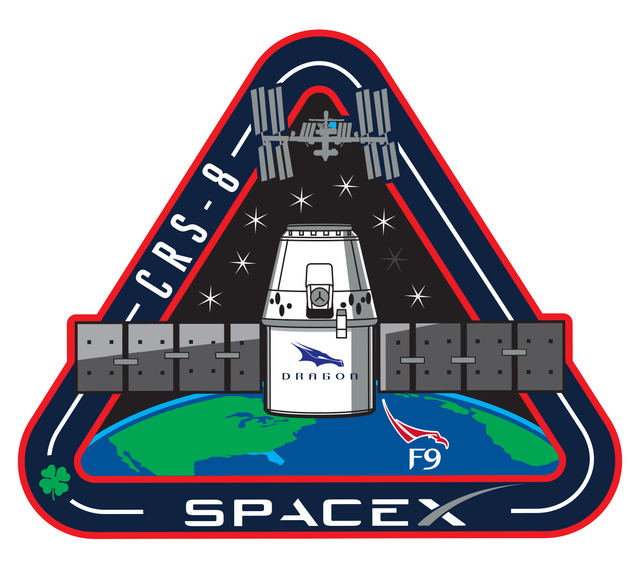
SpaceX CRS-8 mission patch
UPDATE: SpaceX has stuck the landing!  This is first successful Falcon 9 landing at sea, and was shown in real time on the live broadcast.  Congratulations!

SpaceX is sending Dragon to the ISS as it resumes its schedule of resupply missions.  The CRS-8 mission will launch shortly - 4:43 PM EDT (Apr 8, 2016).  As usual for CRS missions, the launch will be from Space Launch Complex 40 at Cape Canaveral Air Force Station.

Once again, the Falcon 9 will attempt to land on the droneship “Of Course I Still Love You” (in the Atlantic Ocean).  These landings are always experimental and secondary to the main mission, but still highly anticipated.  A landing has yet to be made to a droneship, but a successful landing to the Cape Canaveral landing site was accomplished (and was fantastic to watch!), so a success at sea is not at all out of the realm of possibility.  SpaceX has been getting closer and closer.

As a reminder to those familiar with the Dragon resupply missions (or for those of you that haven't previously followed these missions), SpaceX is the only space station resupply vendor that is able to return relatively large amounts of cargo back from the ISS.  Other CRS missions send cargo to the ISS, but since the retirement of the space shuttle there has been a void in the capability to return significant amounts of cargo.

Live feed (and replay) at http://www.spacex.com/webcast
Press kit is at http://www.spacex.com/press/2016/04/07/press-kit-crs-8-dragon-mission

Wednesday, February 24, 2016

UPDATE: SpaceX SES-9 mission scheduled now set for Friday March 4th at 6:35 PM EST

UPDATE: The SES-9 launch has been scrubbed several times due to a variety of different issues - ranging from a fuel loading issue, to weather conditions, to marine traffic in the 1st stage landing zone.   The launch is currently scheduled for the same launch window (starting at 6:35 PM EST) on Friday, March 4th.

SpaceX is taking another step towards returning to a normal launch schedule with the launch today of the SES-9 mission. The mission goal is to deploy an SES communications satellite into GTO (Geostationary Transfer Orbit).

There is a generous 90 minute launch window, with a backup window starting at 6:46 pm EST tomorrow (February 25).

Mission details are available in the SpaceX Press Kit, and will be webcast as usual here.

As this is a GTO mission, the first stage recovery attempt be to the “Of Course I Still Love You” droneship. The nature of the mission does not allow for a return to the Cape Canaveral landing site, and a successful landing at sea has not yet been achieved, and is also not expected to succeed with this mission profile. However, every attempt provides more experience and data to allow SpaceX to eventually make drone ship landings a possibility for those missions where it is required.

Saturday, January 16, 2016

SpaceX Jason-3 Mission is set to launch from Vandenberg AFB at 1:42pm EST (10:42am local time)

The Jason-3 Mission launch is targeted for a 10:42am PT launch from Space Launch Complex 4E at the Vandenberg AFB in California. This mission will use the last of the "pre-upgrade" SpaceX Falcon 9.1 rockets.

The mission is to deliver the Jason-3 satellite to LEO. Jason-3 is a combined effort of NOAA (National Oceanic and Atmospheric Administration), NASA (National Aeronautics and Space Administration ), CNES (Centre National d'Etudes Spatiales - the French space agency), and EUMETSAT (European Organisation for the Exploitation of Meteorological Satellites).

The usual secondary objective pf landing the Falcon 9 first stage will be attempted, with the target being the drone ship “Just Read the Instructions”. Following SpaceX's first successful landing last month at their new, solid-ground landing site, the chances for success seem high. However, the challenge of landing on a floating platform, coupled with the fact that last month's mission used an upgraded version of the Falcon 9, means that the likelihood of success is lower than it will be for upcoming missions.

Thursday, January 7, 2016

The Falcon 9 rocket that was successfully landed is in useable condition

Elon Musk recently tweeted:
Falcon 9 back in the hangar at Cape Canaveral. No damage found, ready to fire again. https://www.instagram.com/p/_-d28bQEc9/

This marks the beginning of the SpaceX reusability vision for reducing the cost of getting goods into space by reusing the launch hardware.

Monday, December 21, 2015

SpaceX Falcon 9 sticks the landing!

SpaceX just accomplished what they have been building up to for years.  They have successfully brought the Falcon 9 booster back to earth and landed it on their new landing site.

The is truly an exceptional feat, and ushers in the beginning of a new era in space flight.  An era where valuable time and resources are recovered and put back into service instead of being dumped into the ocean.

Congratulations!!

[Update - Video of the landing from the landing pad (from the webcast) and a short aerial view taken from a helicopter]


Thursday, December 17, 2015

Test fire of the upgraded Falcon 9


[Dec. 18th] Update: The test firing of the Falcon 9 was completed, and the is data being analyzed.

Elon Musk tweeted:
"Falcon 9 is vertical on the launch pad at Cape Canaveral. Working towards static fire. Deep cryo liquid oxygen presenting some challenges."

It is very encouraging to see a Falcon back on the pad. Hopefully any issues - such as the "deep cryo" LOX fueling (part of the the new Falcon's "densified propellant") - can be sorted quickly in order to have plenty of time to test fire the engines and analyze the data. I don't think this would be the time to rush the process. This flight is important for getting the company back into full swing again, and I'm hopeful about watching a great launch on Sunday. But I wouldn't be surprised if it has to be delayed either, considering the new challenges that inevitably arise with any changes to the vehicle. But the thing that makes SpaceX so exciting is that they keep pushing and are continually moving forward.

Which brings me to what has always been a couched as a secondary goal of recent Falcon launches - landing it in one piece. There have been astonishing close attempts, with each getting closer and closer. And while the payday is earned by hurtling payloads into orbit, having a rocket as big as Falcon hurtle back from space and land itself would be a huge success. And one that would bring a big competitive advantage to SpaceX. There is speculation that the company may be attempting a landing on, well, land. Previous attempts have targeted a platform at sea (the "autonomous spaceport drone ship"), which I assume was to prove it could consistently hit a reasonably small target for safely reasons. But it can do that now, so if the FAA issues a landing permit they seem poised to give it a go.  They've obtained a landing site at the cape designated Landing Complex 1.


So, here's hoping the next few days are fruitful.

Friday, June 26, 2015

SpaceX CRS-7 launch scheduled for Sunday, June 28th

SpaceX logoSpaceX's seventh International Space Station (ISS) cargo resupply mission is scheduled for launch on Sunday, June 28th at 10:21 AM Eastern Time.

Live coverage of the event starts at 10:00 AM (Eastern Time) on the SpaceX Lifestream channel.
While the primary mission of all cargo resupply missions is to get cargo safely to and from the ISS, which is the only true measure of success, most people following SpaceX's reusable rocket goal will be even more interested in the secondary mission goal of attempting to land the Falcon 9 rocket.  This will be the latest in a series of attempts - with each attempt providing data for the next, and getting closer and closer to the goal.  This "must read" article on the SpaceX side provides the details along with some great images and video.

Thursday, April 16, 2015

Video of SpaceX Falcon 1st stage landing attempt [Updated]

[Update] SpaceX engineers have examined the data and believe that sub-par performance of a throttle valve prevented a successful landing.  Per Elon Musk's tweet below, the next attempt will be in two months - which aligns with the CRS-7 mission (scheduled for June 19th).  This is consistent with previous announcements that the next landing attempts would be CRS-7 and CRS-8.
"Cause of hard rocket landing confirmed as due to slower than expected throttle valve response. Next attempt in 2 months." — Elon Musk (@elonmusk) April 18, 2015
SpaceX released this good quality video of the landing attempt to YouTube (watch on YouTube here). At first look I felt disappointment that it didn't stick the landing. That was replaced almost instantly by awe at that though that "this thing fell from the sky - not just the short distance on the video". Wow. As the rocket is just tipping over the "down hill" thruster (at the top of the stage) gives it's all to try to keep the the rocket vertical - but there's obviously too much inertia to overcome.


So, for an effort whose chances were estimated at 50/50, it was a brilliant achievement.

Tuesday, April 14, 2015

SpaceX "coming attractions" - what's next? [Updated]

The next mission kicks off in just 10 days, followed by a packed launch manifest for the remainder of the year and beyond.  Here is the schedule as it stands now.

April 27th [Updated]
TürkmenÄlem, the first telecommunications satellite for Turkmenistan
May TBD
Dragon V2 (manned spacecraft) pad abort test - while not actually a "flight" is worth noting (NASA)
June TBD
Second launch of Orbcomm satellites to complete the OG2 constellation
June 19
ISS resupply mission CRS-7 (NASA)
July TBD
SES-9 geo-transfer orbit (GTO) mission, with the SES-9 spacecraft joining the previously launched SES-8 in geosynchronous orbit
July 22
Jason 3 Earth observation satellite for monitoring and measuring the world’s oceans (NOAA)
Sept 2
ISS resupply mission CRS-8, Bigelow Aerospace's Bigelow Expandable Activity Module (BEAM) - an expandable (as in inflatable) compartment (NASA)
Sept TBD
The second dual-GTO mission for the Eutelsat 117W B and ABS-2A satellites
Dec 9
ISS resupply mission CRS-9 (NASA)
Mar TBD (2016)
Falcon Heavy Test Flight!
TBD
AMOS-6 satellite
JCSat 14 satellite
SAOCOM 1A and 1B Earth observation satellites (separate launches).